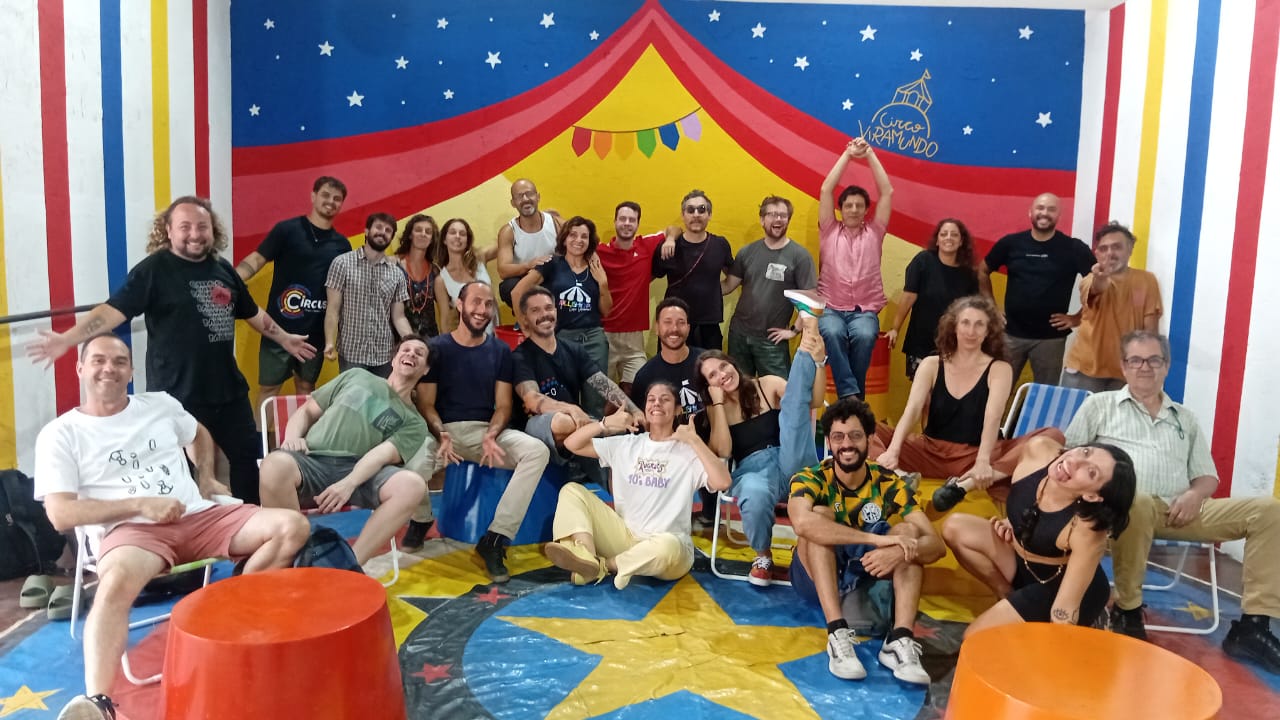
From 19 to 25 February 2026, the Summer Circus Research Week took place, organised by the Circus Research Lab at the Faculty of Physical Education (FEF) of Unicamp, in Campinas, Brazil, under the leadership of Professors Marco Bortoleto and Rodrigo Mallet and their team of associate researchers.
Fifteen people were selected from 50 applications, primarily from Latin America and Brazil, with a few participants from the rest of the world (Europe, USA, Canada). Our Director of Continuing Education & Professional Development, Mathilde Perahia, had the privilege of taking part in group discussions and presenting En Piste and its role in the development of Canadian circus.
The seminar took place over seven intensive days of presentations, collective discussions, sharing of resources and projects, and reflections and plans for the development of the circus. It was also an opportunity to discover a (very) small part of the region’s rich circus ecosystem in the São Paulo–Campinas area.
Unicamp and the circus
In 2006, UNICAMP established the “Circus Arts Study and Research Group”, now known as the “Circus Research Lab”, to provide training for teachers, artists and researchers in the circus arts. Today, this laboratory brings together 28 associate researchers, all of whom are engaged in the study of the circus, with more than half working at various universities in the region. Today, this laboratory brings together 28 associate researchers, all of whom are engaged in the study of the circus, with more than half working at various universities in the region.
They have published over 120 scientific articles, 15 books and dozens of educational resources (educational videos, podcasts, etc.), aimed at producing scientific data and disseminating high-quality and safe teaching practices in the field of circus arts. Unicamp has distinguished itself through its ability to integrate the circus into the university, forging links with other disciplines and faculties beyond physical education, thereby broadening its scope of action.
Brazil is an inspiring example of a circus-rich country where traditional circus has been recognised as cultural heritage and where the circus has made its way into the university. With over 200 festivals, countless companies, families and circus schools Brazil is doing a great job of preserving, structuring and connecting the Brazilian, Ibero-American and international circus communities.
Summer Circus Research Week :
Among the many topics discussed, the first concerned the major challenges facing the circus today and the actions that could be implemented to continue supporting our sector.
Indeed, discussions on circus training were central to the week’s proceedings: the structuring of training pathways, the accreditation of trainers and the recognition of prior learning, and bridges to accommodate different career paths. Concrete examples were presented:
- The Spanish Ministry of Education now recognises circus as a discipline to be included in the curriculum and has set up a working group on circus education. A proposal to structure the training pathway is currently being drawn up in a way that considers all profiles and career paths.
- The Circonsenso project, supported by Creative Europe, aims to create a training of trainers programme based on pooling existing initiatives in Spain and Latin America within the social, recreational and vocational sectors.
In this context, whilst not being presented as the ultimate goal of a career path, the presence of circus in universities was discussed and unanimously deemed fundamental. The university is a place to produce knowledge, a place where knowledge intersects, a place of resistance to hegemony. Circus, just like the other major arts, has its place there, in relation to numerous disciplines.
These training issues were considered so that one does not exclude the other, with a view to complementarity and diversity, following the logic that the more training pathways there are, the more our sector is enriched and expanded. The subject of memory was particularly prominent in a country where the circus forms part of the popular cultural heritage, as were discussions on aesthetics and dramaturgy, and also on policies and production contexts.
Together, we recognised that the circus generates specific knowledge and is a field of knowledge about the world, and that we still need to produce (qualitative) data to support the societal value of the circus at all levels. It also became clear that the value of the circus lies as much in practice as in the creation and transmission of works. The importance of experiencing the circus was highlighted.
A key theme of the discussions thus focused on the place of the circus in society, and what the circus can offer the wider social world beyond its role in presenting performances. Léandro Mendoza called for a new social pact for the circus: what can the circus do today within society and for society? What societal commitment do we wish to make for the coming years? This new vision must emerge from the community itself; we must be the agents of change.
This eventful week was an opportunity to pool our knowledge, our experiences, our perspectives and our intentions. This is the start of a collaboration intended to be merely a first bridge that will continue to extend beyond this small group.
As En Piste prepares to begin work on the 2027–2037 circus Strategic Plan, these meetings are a powerful lever for thinking about the Canadian circus in relation to other sectors around the world, given that many issues overlap.