
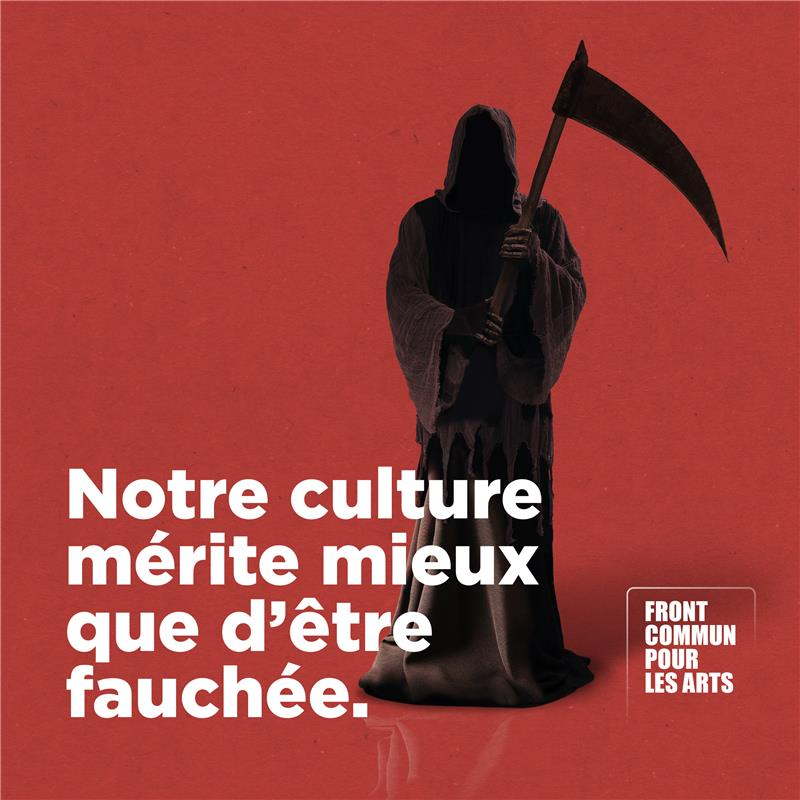
The 21 organizations of the Common Front for the Arts present their pre-budget brief to the Quebec government.
In the autumn, the Common Front sounded the alarm and already called for clear actions to guarantee the sustainability of the cultural sector and to face the challenges that are shaking the artistic community:
· Increase the permanent credits of the Conseil des arts et des lettres du Québec (CALQ) to $200 million starting next fiscal year;
· Aim to consolidate CALQ budgets by making all of its credits permanent;
· Systematize the indexing of CALQ programs;
· Make local culture a real government priority with a long-term vision for the thousands of artists and cultural workers in the sector.
Investment is essential to curb the deterioration of the cultural ecosystem. The significant increase in costs, which has accelerated in recent years, is seriously undermining the creation, production, and dissemination of works, as well as the careers of artists and cultural workers.
“We’re not asking for these investments for development, we’re asking for them to maintain operations. We saw the programming cuts that broadcasters have been announcing since the beginning of the year coming. That’s what we’ve been telling the government all fall.” — Julie-Anne Richard, Executive Director, RIDEAU
READ THE MEMOIR: https://enpiste.us4.list-manage.com/track/click?u=72a4f14eb475b7423175af939&id=f045e6be31&e=c7c51211fe
Very real consequences for our culture
The consequences that the cultural sector will suffer if pre-budgetary demands are not met are inevitable and are already being felt. In all regions of Quebec, as well as in the Capitale-Nationale region and Montreal, organizations are reducing their programming due to lack of sufficient funding. These confessions echo the news of the last few days, which confirm the critical state of the situation: demonstrations, cancellations, closures, reduced programming, artist testimonials, and much more.
The consequences have been clearly presented to the Quebec government for several budgetary years. This year again, the cultural sector submitted a rigorous pre-budget brief to the offices of the Prime Minister, as well as the Finance and Culture departments, demonstrating the now-perceptible effects of insufficient funding:
· Devitalization of our ecosystem: suspension of audience development projects and activities, reduction in support for the next generation and reduction in the international influence of our culture;
· Reduction in the offer to citizens: fewer shows and exhibitions, increase in ticket costs; fewer tours and regions of Quebec less well served in terms of cultural offers;
· Deterioration of working conditions for thousands of artists (already in precarious situations) and cultural workers.
“We must act in the next budget year to save an entire part of the Quebec artistic ecosystem, which is rich in our cultural identity and our values, and which does us proud.” — Caroline Gignac, Executive Director, Conseil québécois du théâtre (CQT)
“100% of the population consumes cultural products across all disciplines. It’s time we started thinking about investing in local cultural products before customers change their habits and invest massively in cultural products from elsewhere, which are costing us all money.” — François Colbert, full professor at HEC Montréal and holder of the Carmelle and Rémi Marcoux Chair in Arts Management
“One of the fundamental pillars of our society, Culture, what makes us who we are, is no longer simply weakened; rather, it has been exposing deep cracks for several days and is literally threatening to collapse” — Tania Kontoyanni, President, Union of Artists (UDA)
Representatives of Common Front organizations, from left to right: Nadia Drouin, Émmanuelle Hébert, Mo Carpels, Dominic Trudel, Caroline Gignac, Camille Cazin, Julie-Anne Richard, Catherine Bodmer and François Colbert during the presentation of the brief. Photo Mariane Beauchamp
About the Common Front for the Arts
The Common Front for the Arts brings together 21 organizations representing various artistic and cultural sectors across the province. United by a common goal, these organizations work to defend the vitality, diversity, and future of culture in Quebec. In the face of economic pressures and social challenges, the Common Front advocates for government investment in the cultural sector to ensure the sustainability of Quebec’s arts and creativity.
– 30 –
Member Organizations of the Common Front for the Arts
Association of Contemporary Art Galleries (AGAC)
Association of Parallel Cinemas of Quebec (ACPQ)
Professional Association of Show Promoters – RIDEAU
Quebec Council of Arts and Crafts (CMAQ)
Quebec Music Council (CQM)
Quebec Theatre Council (CQT)
DOC Québec
En Piste, National Circus Arts Group
National Federation of Communications and Culture (FNCC-CSN)
Quebec Musicians’ Guild (GMMQ)
Independent Arts Research and Experimentation Peer Group (REPAIRE)
Street Arts Group (RAR)
Association of Visual Artists (RAAV)
Association of Self-Managed Artist Centers of Quebec (RCAAQ)
Quebec Storytelling Group
Quebec Dance Association (RQD)
Culture 360° Network (CRC)
Quebec Cultural Periodicals Development Society (SODEP)
Quebec Museum Society (QMS)
Union of Artists (UDA)
Union of Quebec Writers (UNEQ)