
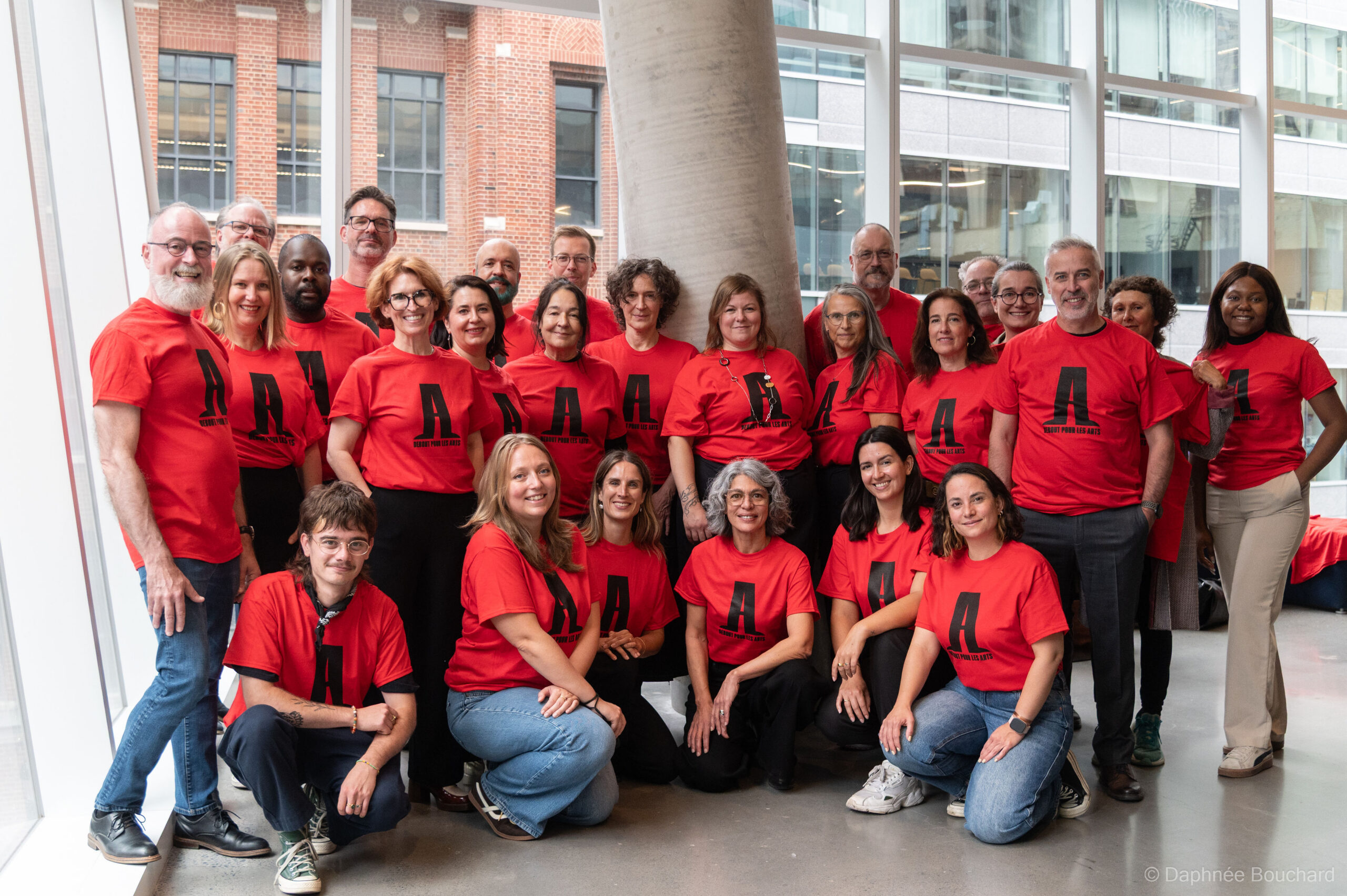
This letter is co-signed by 36 cultural organizations, members of the Front commun pour les arts
The survival of our culture deserves more than three minutes of debate
Some things disappear quietly, but their absence will have very real and lasting effects on the lives of Québecers.
A school that cancels a cultural outing or gives up buying books. A company that cuts back on the number of productions it creates. A tour that no longer reaches communities outside major urban centres. An artist’s studio that closes its doors. A presenter that features fewer young creators because it can no longer afford to take financial risks. A cultural venue that reduces its hours open to the public.
Taken individually, each of these cutbacks may seem trivial. Taken together, however, they point to something far more serious: the gradual erosion of our collective ability to tell our stories and pass on who we are. And, ultimately, to make our society more cohesive and healthier.
During the last two televised debates, the five party leaders were extensively questioned—and rightly so—about health care, housing, homelessness, the economy, and public finances. These are fundamental issues. But it would be a serious mistake to view Québec’s cultural survival as peripheral to the major issues in this election. In fact, so far, our politicians seem to have given up on providing an ambitious answer to a question that is nonetheless essential: what is their vision for Québec in 15, 20, or 30 years?
This retreat amounts to reducing politics to administration and stewardship. But administering a society is not the same as offering it a future. Governing means, first and foremost, choosing what we want to make possible. That is why we refuse to allow culture to remain, once again, a peripheral issue in the election campaign.
Modern Québec was not built by treating culture as an optional extra. Generations before us understood that the affirmation of a French-speaking nation in North America depended on its ability to create its own institutions, support its artists, produce its own works, and make them accessible to the public throughout the province.
We did all of this because we had a clear and ambitious vision for Québec and its citizens. That is what is sorely lacking today, and why the survival of our culture must be addressed in the next debate with all the attention such an issue demands. Taking culture seriously requires us to move beyond day-to-day management and ask ourselves what we want to be, what we want to pass on, and what we want to become.
It may be reassuring to believe that Québec culture is too deeply rooted to be truly threatened. However, a culture does not disappear overnight: it gradually becomes less present, less visible, less often passed on, and less capable of reaching new generations.
Then, one day, it ceases to be the heart of a shared experience. And it fades away.
That is why we are once again calling on our political leaders to Stand Up for the Arts and culture, and we demand that arts and culture be given a real place in the upcoming leaders’ debate.
Between now and October 5, we also invite every voter to demand a clear answer to this question: What will you do now to ensure that 20 years from today, there is still a vibrant and distinctive French-language culture in North America?
Members of the Front commun pour les arts:
- Association des galeries d’art contemporain (AGAC)
- Association des cinémas parallèles du Québec (ACPQ)
- Association professionnelle de diffuseurs de spectacles (RIDEAU)
- Conseil des métiers d’art du Québec (CMAQ)
- Conseil québécois de la musique (CQM)
- Conseil québécois du théâtre (CQT)
- DOC Québec
- En Piste, regroupement national des arts du cirque
- Guilde des musiciens et musiciennes du Québec (GMMQ)
- Regroupement de pairs des arts indépendants de recherche
- et d’expérimentation (REPAIRE)
- Regroupement des arts de rue du Québec (RAR)
- Regroupement des artistes en arts visuels du Québec (RAAV)
- Regroupement des centres d’artistes autogérés du Québec (RCAAQ)
- Regroupement des médiatrices et médiateurs culturel·les du Québec (RMCQ)
- Regroupement du conte au Québec
- Regroupement québécois de la danse (RQD)
- Réseau Culture 360° représentant les 15 Conseils
- régionaux de la culture
- Société de développement des périodiques culturels québécois (SODEP)
- Société des musées du Québec (SMQ)
- Union des artistes (UDA)
- Union des écrivaines et des écrivains québécois (UNEQ)