Contributing to human development and to building a more inclusive society through the practice of circus arts.
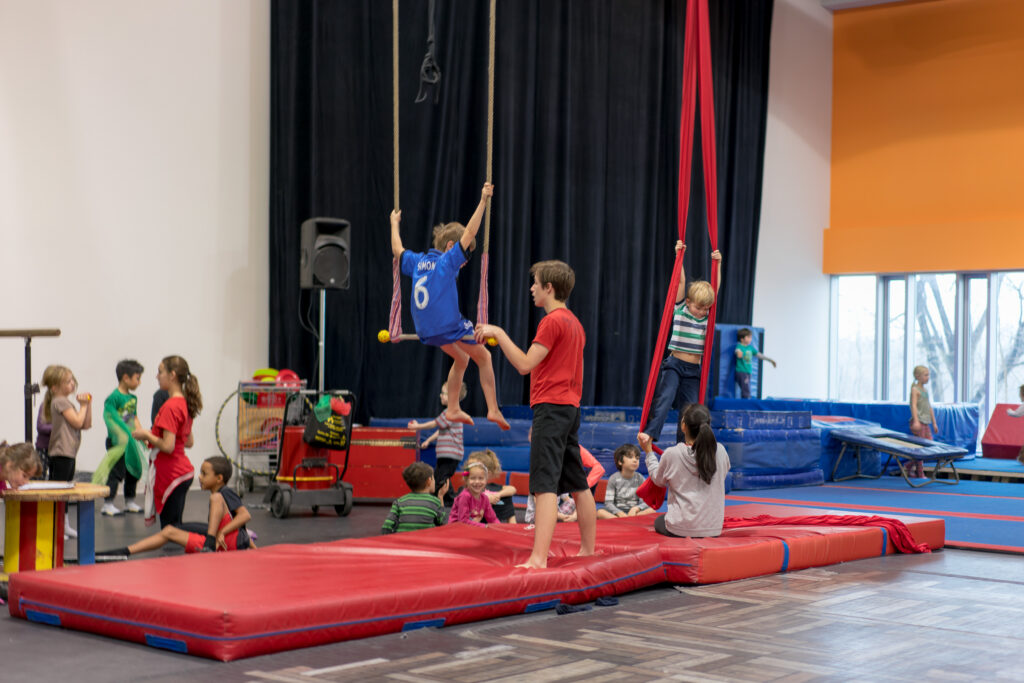
Circus Education aims to facilitate and structure the teaching of circus arts in schools by supporting coherent, high-quality pathways, from primary education through to the professional sector, across Quebec.
Building on a professional sector recognized internationally, Quebec circus benefits from rich and diverse expertise. While some schools have already integrated circus into their curriculum or extracurricular activities, these initiatives remain limited or insufficiently coordinated, and lack shared tools to ensure consistency and continuity across pathways.
Circus Education seeks to address this need by fostering collaboration between circus schools and the school system, supporting teacher training, sharing resources, and strengthening connections between the education and cultural sectors. The initiative aims to move beyond siloed approaches to build a collective, complementary, and sustainable vision for circus arts education in Quebec.
Our Areas of Action
Collaboration – Mieux se connaître pour mieux travailler ensemble
Mapping circus arts education resources in Quebec, facilitating a community of practice, and creating meeting spaces to encourage collaboration and knowledge sharing.
Formation – Former en phase avec le terrain
Developing and delivering training adapted to the realities of the school environment and improving access to existing programs and resources for teachers.
Valorisation – Faire rayonner le cirque en éducation
Highlighting the benefits of circus arts, sharing pedagogical resources, providing a centralized digital access point (including job opportunities), and supporting school and extracurricular initiatives.
Représentation – Porter la voix du cirque
Representing the sector with government ministries and participating in educational conferences.
Circus education committee
Facilitated by the En Piste team, the Circus Education Committee’s mission is to guide strategic reflection on the development of the training pathway, from primary school to the professional level. It contributes to the development of an action plan and meets regularly to discuss project progress and strengthen links between circus education structures. En Piste also oversees the project’s coordination and implementation.
Committee Members:
- Tim Roberts, Executive Director, Quebec Circus School
- Kim Polisois, Physical Education Teacher, Horizon-Soleil Elementary School
- Patrice Aubertin, Co-Executive Director, National Circus School
- Marie-Josée Lareau, Executive Director, Verdun Circus School
- Karine Lavoie, Executive Director, Cirque Hors Piste
Benefits of circus arts
Practicing circus arts is a powerful driver of holistic development for young people. It promotes physical literacy, social development, and well-being, while supporting school engagement and mental health. Studies notably show that circus helps girls stay active longer and strengthens their sense of belonging.
As an inclusive alternative to competitive sports, circus emphasizes individual progression, perseverance, and cooperation rather than performance. It fosters self-esteem, solidarity, creativity, and measured risk-taking within a safe and supportive environment. It is a meaningful lever to enrich both educational pathways and leisure experiences for young people.
Discover two articles on the benefits of circus arts in schools and inspiring initiatives in Canada:
- L’essor des arts du cirque dans l’éducation physique : une façon amusante et engageante d’améliorer les compétences physiques et la culture de l’activité physique
- The many Benefits of Learning Circus Arts at School
Project background
In the summer of 2018, the Government of Quebec mandated the National Circus School (NCS) to develop the circus arts training pathway.
In fall 2018, the Research, Innovation and Transfer Centre for Circus Arts (CRITAC, now HUPR) was commissioned to map recreational and preparatory training and analyze best practices.
Following this study, the NCS, in collaboration with the sector, developed three structuring tools to professionalize circus arts education:
- Circus Arts Training Framework Plans : to structure the training continuum, from community recreation to secondary school, including school initiation and circus concentration programs at the primary level;
- National Certification Program for Circus Arts Instructors : to recognize competencies and support professional qualification;
- Circus Training Space and Equipment Guide : to support the development and management of specialized infrastructure.
At the same time, actions were undertaken to strengthen and promote the training pathway. In 2023, at the initiative of En Piste, two major events were held: the Grand Meeting on Circus Arts Education in Montreal and a similar event in Quebec City. Supported by the Ministry of Culture and Communications (MCC), the event brought together nearly 80 participants from Quebec, Alberta, and the United States. It provided an opportunity to mobilize the educational community and present the pedagogical tools developed as part of the training pathway initiative.
In October 2023, En Piste signed an agreement with the MCC confirming dedicated funding for the development and structuring of the pathway.
The years 2025 and 2026 mark a key phase for the development of the circus arts training pathway in Quebec, with the implementation of an action plan, the hiring of a project manager, strengthened collaborations, and the deployment of structuring tools to sustainably support the education sector and emerging talent.
Circus education committee:
 |  |  |  |  |
Funded/supported by: